ChatGPT and Textmetrics: mix the two for the best results!

Brand new and ready to use; Textmetrics has undergone a total makeover. Not only that, are you ready for the future of recruitment? Get ready!

Surely you’ve heard of ChatGPT. A tool used for easy, quick content to make your e-mail just a tad funnier, or completely unburdens you when making your shopping list for dinner with your friends. Super convenient, of course!

But how does AI help you write your job postings?

Very simple: by mixing ChatGPT with Textmetrics' smart algorithms!

Step 1. Kindly ask ChatGPT to write an ironclad job description for you.

-> It feels a bit generic, don't you think? Indeed, it is! Something mega important is missing, which is: Your organization's employer branding and tone of voice!

Step 2. So you copy the text into Textmetrics and it gives you instant feedback and suggestions for improvement. Yes, wow! All on-brand, gender-inclusive and readable for your target audience.

Step 3. It's almost impossible to imagine, but we're going to make it even easier for you. We are currently working intensely to integrate ChatGPT into Textmetrics so you can do all your writing in one place!

Relax, the AI of the future does the thinking for you.

Want to learn more about Textmetrics and how it can help you and your business? Visit our website here.

ATS software supports every stage of the recruitment process. It helps to achieve a faster, more efficient and often more effective process. In this blog we tell you more about successfully using an ATS in the recruitment process. To get a grip on the complete process, we have broken down the different recruitment phases.

ATS for sourcing candidates

Finding suitable candidates is one of a recruiter's most important tasks. By using an ATS for sourcing candidates, recruiters can find potential candidates faster and more efficiently to add them to their talent pool. It can also help organize and evaluate these candidates for recruitment in the future.

The system is integrated with various job sites, job boards and social media used by candidates. This allows recruiters to (re)post jobs online quickly and easily. When candidates apply, their data is automatically processed in the ATS system.

Might also be interesting: OTYS Multiposter 

ATS for candidate management

When a candidate has responded to one of your jobs, a profile is automatically created. This profile contains all the information entered by the candidate. Any information supplied at a later stage of the process is also automatically incorporated into the profile. During the candidate's recruitment process, information and tags are added to the profile, clearly indicating the candidate's status and qualifications. Even if the candidates prove unsuitable now, they remain in the ATS database, so they can still be placed in the future. The (almost) automatic creation of this talent pool is invaluable to any recruiter. 

ATS for candidate selection

After the candidate's profile is created, the system automatically checks all information to determine if the candidate matches certain sets of requirements. The system can easily scan for manually specified skills by the recruiter such as experience, education, certifications.

Based on this information you can then determine whether the candidate may proceed to the screening phase. This example is one of the main reasons why an ATS system removes so much workload and makes recruitment so much more efficient.

Might also be interesting: OTYS Hunt & Select

ATS for managing hiring

Once the desired candidate is chosen, the ATS can easily initiate the next steps. For example, the system can immediately generate templates where the recruiter only needs to check the terms and conditions and press the send button. When the candidate accepts the proposal, this too is automatically processed in the candidate's file. 

ATS for onboarding

Once a candidate is hired, the ATS can be used to assign and track the progress of onboarding activities. This can apply to company-wide onboarding or role-specific onboarding activities. Specific tasks and deadlines can be tracked within the ATS to ensure the new employee stays on track.

Studies show that candidates who receive proper onboarding are 69% more likely to stay with a company for three years or more. The ATS supports management of administrative operations. 

ATS for optimizing processes

Most ATS offer reporting capabilities that allows recruiters to identify bottlenecks and inefficiencies in their process and workflow. This way you are always shown where there is room for improvement. ATS give recruiters access to a wealth of data to drive (and improve) their hiring decisions and processes.

Today more and more companies are using Artificial Intelligence (AI) during the recruitment process. While AI offers many benefits, applicants may as a result also find themselves in an anonymous process. This can lead to a lack of engagement and decrease of interest in the job posting. Therefore it is crucial to maintain the personal aspect of the recruitment process, even when AI is used. In this blog we will discuss 5 ways to keep the recruitment process feeling personal, even when using AI.

Keep the communication personal

Make sure e-mails, messages and other forms of communication to candidates feel personal and you do not use standard templates. For example, use personalized communication by using the applicant's name in e-mails or by referring to specific details from their application. AI can also be an extremely useful supporting tool for adding those details in the communication. In addition, offering a personal interview with a recruiter or HR manager can help increase applicant engagement.

Combine human and bot

Another way to keep the process personal is to combine the use of AI with human evaluation and feedback. You can for example let AI technology do the initial screening, but integrate human evaluation into the recruitment process, by having recruiters themselves then evaluate candidates based on their personal experiences and soft skills. Something humans often do better if not differently than AI.

Make smart use of video interviews

AI can be used to conduct automated interviews with candidates, such as through video interviews. Speech and facial recognition technology can be used to analyze and assess candidate responses. But make sure the candidate feels comfortable and add personal touch points, such as a welcome message or a personal introduction to the company.

Utilize smart chatbots

Chatbots can be used to greet candidates and answer questions during the recruitment process. By using chatbots, candidates can feel more personally treated and the process can still be largely automated this way.

You may also find this interesting: Smart writing for Recruitment Chatbots is done like this 

Let candidates know that they are important

Send candidates regular updates on the recruitment process and the status of their application. Make sure candidates know that their applications are taken seriously and that they are valued as potential employees. This can be automated with the right software (such as OTYS) to further reduce the time it takes to keep candidates updated. Take, for example, the track-and-trace page for candidates developed by OTYS and Joboti for Strictly People.

In short…

The use of AI can improve efficiency, reduce recruiters' workload and improve candidate quality. However, it is important to remember that AI is not the only solution. It is important to have a balanced approach that combines AI with human interaction and evaluation to achieve the best results with candidates.

By using AI combined with OTYS Recruiting Technology, recruiters can make their recruitment process more efficient while also maintaining the human side of the process. Contact us to discuss the possibilities or send an email directly to customersales@otys.nl.

In today's tense job market, simply posting a vacancy on Facebook is seldom enough. Attracting new staff depends on a successful employer branding strategy. Perhaps the most visible part of this? Your vacancy website.

Is your corporate recruitment site attractive (and clear) enough to convince a candidate to apply for a job with you? Does it sufficiently display your organization's identity? Or is it just a listing place for your vacancies? A good vacancy website contributes to strengthening your employer brand. Therefore I have tried to figure out what exactly makes a good employment website.

Texts that actually have something to say

Although today's candidate is more visually oriented than before, you (of course) cannot escape having texts on your website. How else are you supposed to get your message across? But, texts can be more than a boring enumeration of soft and hard skills you are looking for in an employee. Good texts contribute positively to radiating your corporate culture and propagating the core values you stand for.

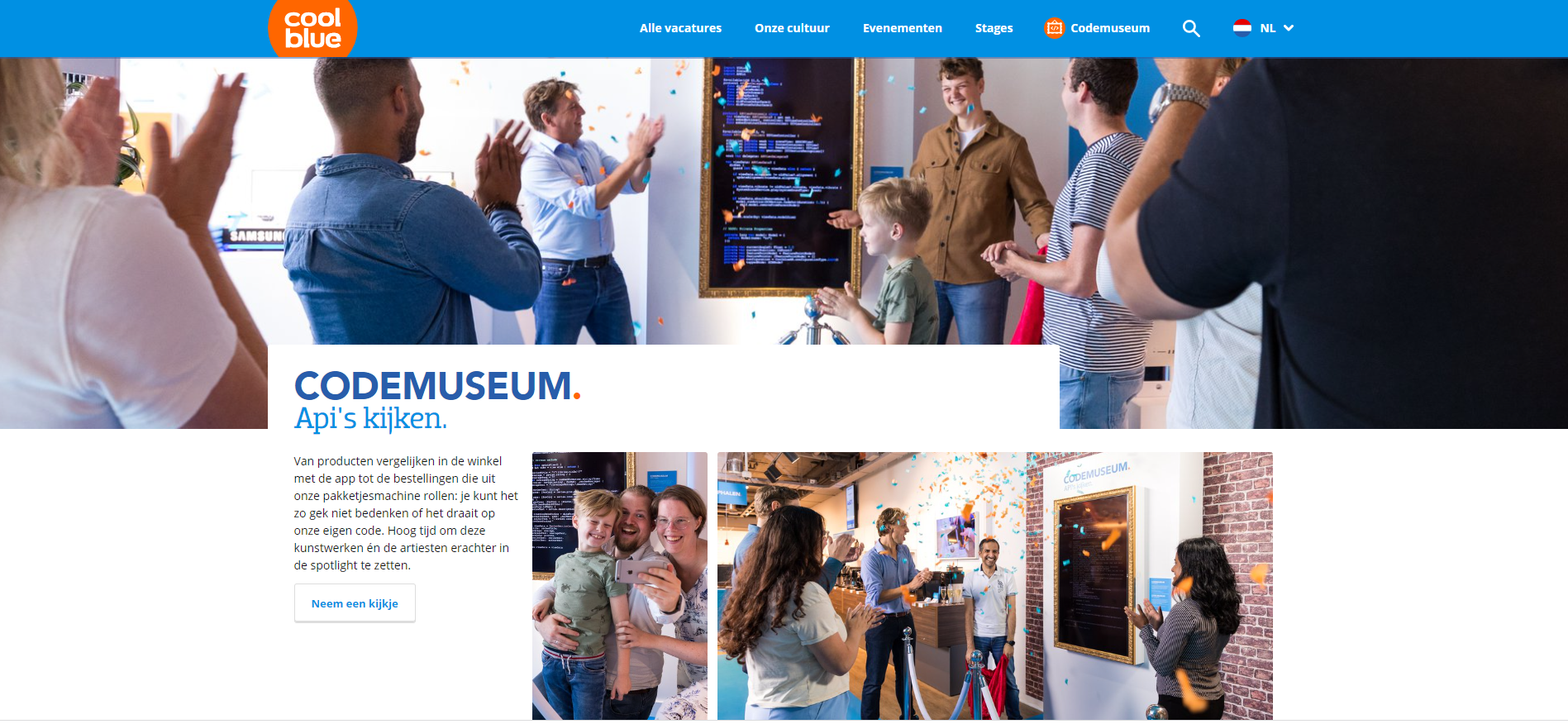
Possible the leader in this field? Coolblue. With their mission "anything for a smile" they have been conquering the e-commerce market since 1999, but also secretly my heart when it comes to labor market communication. Like their mission, the texts on the website do everything to put a smile on the faces of the reader. They achieve this very effectively with phrases like “Code museum. Bits and pieces.” or "Get your black belt in pleasing candidates."

Keep in mind that humor on a vacancy website can be either a smash hit or a complete miss. Awareness of the kind of organization that you are and the kind of employee that goes with it is key. So humor is not a requirement for a strong (corporate) story. The Dutch De Belastingdienst (Tax and Customs administration of the Netherlands) demonstrates this nicely on their vacancy website. Less informal than Coolblue, but full of to the point text that immediately makes it clear to you what kind of organization you are dealing with, without it ever feeling boring or stuffy.

An organization with personality

If you've ever googled "tips for a good vacancy website", you're bound to have come across the following advice: make it personal. But how do you make a vacancy website personal? One way is to give your employees a platform to keep your story as personal and authentic as possible. Show what the colleagues within your organization really look like. Coolblue for instance shows employees through photos and their shared company outings.

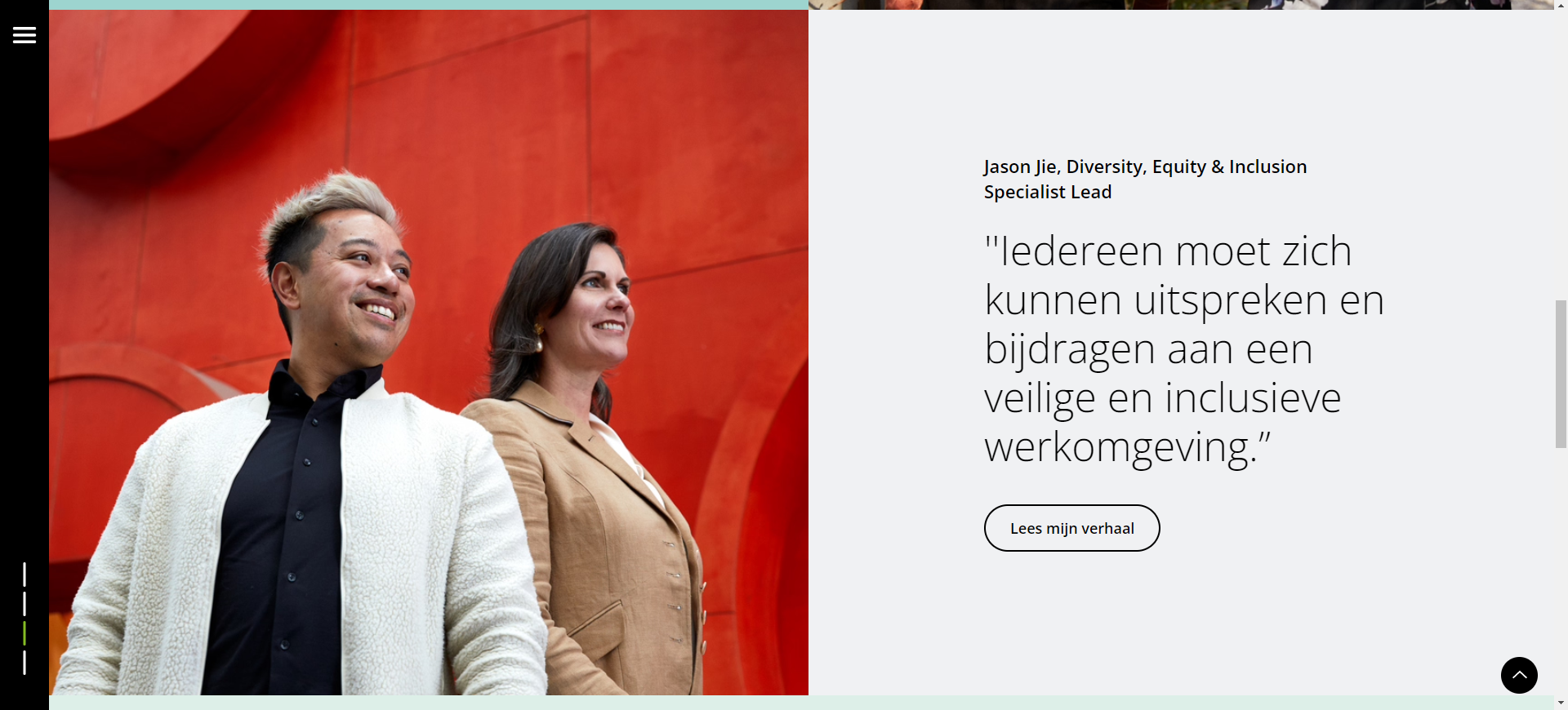
One company whose entire recruitment site strategy is built around the people behind the organization, and which in my opinion does a fantastic job, is Deloitte. On the homepage, they put their people at the center and you are immediately triggered to read the personal stories of the employees. The portraits of these employees really take center stage. In an article by Werf-en, Sjoerd Kuipers of Stuurlui writes "be diverse" as one of the 10 commandments for corporate recruitment websites, but disingenuous diversity is something a candidate can spot from a mile away. It’s better to actually show who really works for you.

Deloitte is not the only successful worksite focused on showcasing your potentially future colleagues. A.S.R. also approaches their vacancy website from this strategy. On their website you can scroll through employee testimonials and stories as if you were looking for a job post, that's how many there are. This really gives you as a job seeker a good idea of the kind of workplace you will end up in. The people at A.S.R. are really their focal point, and this becomes quite clear when you see all their communication.

But, it can also be a little more low-key. At a company like vanHaren you won't see a photo on their vacancy site without an employee on it, and they (clearly) also put their employees in the foreground. They really want to show and convey what kind of people work at vanHaren. Not only in the stores, but also at headquarters and within logistics.

Pictures say more than a thousand words

With good friends you usually need but half a word. With good vacancy websites, the same is also true. And, some companies lend themselves perfectly for a visual rather than a primarily textual story. The Department of Defense undertands that all too well. The hero banner, this is the first image and typically the eye-catcher of a  recruitment website, shows us a visual story that immediately triggers a feeling. It conjures up an emotion, it makes you want to be part of that story.

Organizations like the Department of Defense are great for building a and sometimes also building upon an existing image. The Dutch Police force, for example, also achieves this quite successfully with a video reel in their hero banner. But De Belastingdienst, with a significantly stuffier image as an organization, also perfectly knows how to use video to set an atmosphere and convey a feeling. Take a moment to click through their expertise pages and you can’t deny also being a little bit impressed by the story, right?

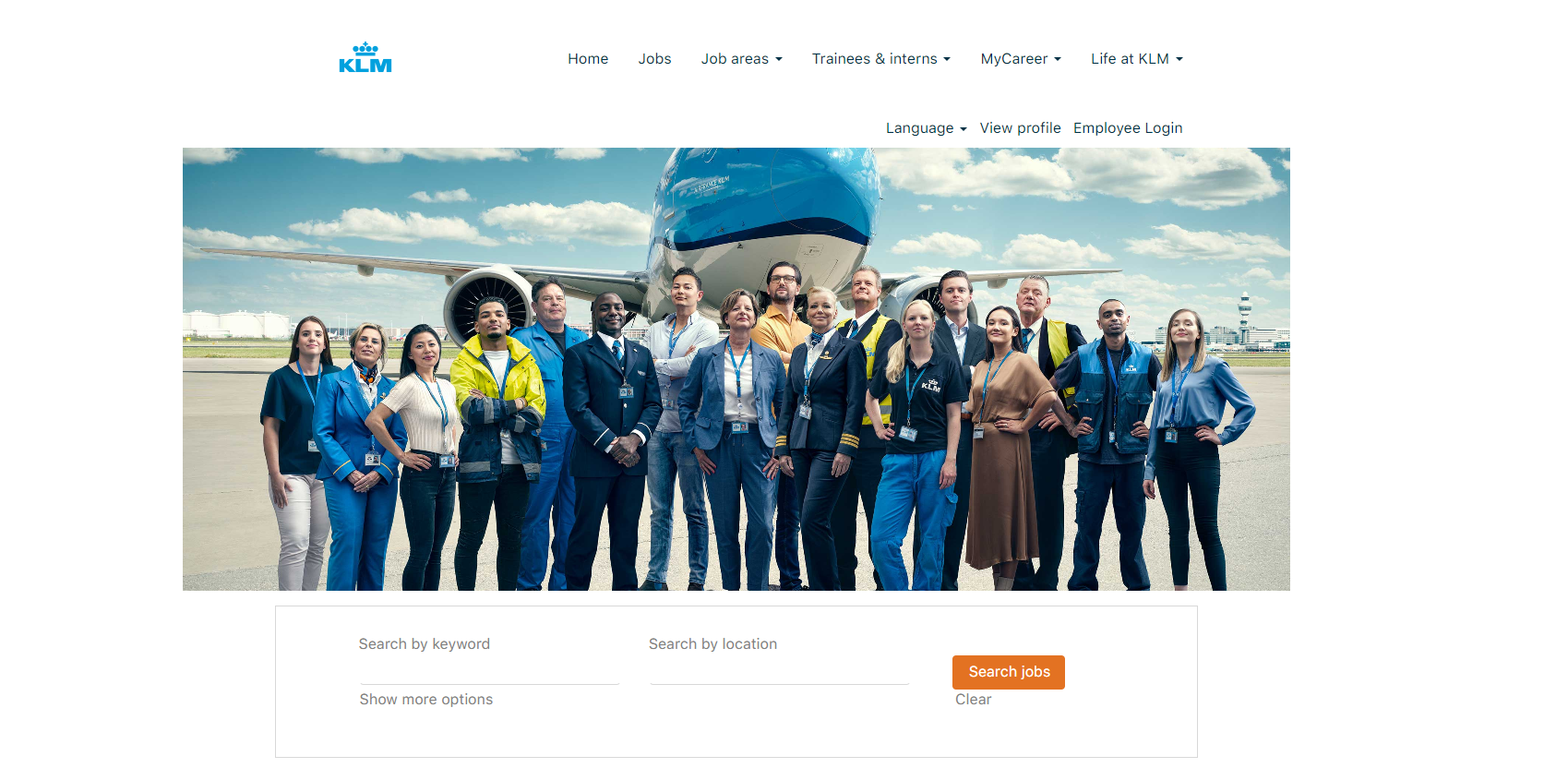
On the other hand, developing video's (or having them developed) is not a cheap job. But even with stills you can effectively portray a company's image, as KLM proves on their website. Picnic in turn does this by deploying region-specific recruitment pages, such as one at Utrecht. Perhaps as a Utrechtian myself I am somewhat biased, but I think the personal touch works well.

Design does not undercut usability

You may dress up the website and the employer very nicely, however if a website does not adhere to the minimum conditions of a good vacancy website, the site will never work for them. So, you will have to think about the image, about your employer branding strategy, about your personality as an organization, but you will also have to ask yourself the following questions: as a candidate, am I able to apply easily? Do I have the possibility to set up a job alert? Are there filters for the open jobs to make searching easier? Is there a clear menu navigation?

In other words, did you adhere to the best practices for a vacancy website. Lastly, as well-scoring website, we will take NS as an example for the following "best practices" checklist.

  • Logo can be found at the top left and is visible on each individual page.
  • There is a clear navigation of the website.
  • The corporate identity of the vacancy website is in line with the corporate identity of the organization. Preferably with recurring recognizable style elements.
  • There is a search bar on the homepage that makes it easy to search for jobs. A positive aspect of NS is that this is designed like the route planner on their regular website.
  • Good use is made of (moving) images.  
  • A Job Alert is present. Extra pluspoints for showcasing the job alert on the homepage and throughout several points in the customer journey.
  • The extensive employee content.
  • There is a (visual) representation of what the application process will look like.

A vacancy site that works

But in the end, what do all these examples have in common? What makes a good vacancy website? The fact that they all tell a clear and unambiguous story. The personality of the organization shines through in both text and image.

In addition, it then helps if it also has a unique identity. You'll get even more points if the website is also user-friendly and easy to navigate.

Have you already evaluated your website, maybe compared it to the checklist above and aren’t you scoring to good? Are you and your organization running into employer branding issue, or don’t you have any idea where to start? Please don't hesitate to contact us. We have spent years specializing in recruitment websites that work. We also have several professional and knowledgeable partners, with whom we connect, who would love to be your sparring partner.

Just to name a few OTYS partners: Stuurlui, Rankdata, GetNoticed or Booston. Ready for a new step? Take a look at all our web solutions. 

What came first? The shortage of staff or the shortage of recruiters? With the labor market tightening, which has only worsened since the corona pandemic, the demand for recruiters has also consistently increased.

More work, less recruiters

Back in 2021, Indeed reported that the demand for staff-recruiters was up 90% from the previous year. In fact, the demand for recruiters was as much as 42% higher than before the pandemic. A trend LinkedIn further confirmed in their report. In 2021, there were 6.8 times more recruiter jobs posted on the business social media platform. And, although this trend line seems to be slowing down somewhat in 2023, the demand for recruiters still seems to be higher than in other industries. This is partly explained by the fact that the demand for sufficient and most preferably good staff is still (too) high.

The flexible employment agent

Fortunately, technological developments are such that we are massively automating and robotizing to cope with these shortages. The shortage of labor migrants has, for example, lead to the use of robots for picking tomatoes in more and more places. In the transport sector, you see that manual order picking is disappearing at an accelerated rate, according to Han Mesters of ABN AMRO.

Employment agencies will also have to be flexible and adapt to the (now not so) new situation. This means not only offering other forms of contracts, but also making smart use of their own resources. For example, using smart tools to fill in the gaps can already help you avoid losing any potential new employees and make the most out of all opportunities.

Everything automated from the start

By looking at what areas of the recruitment process can be automated, a company can easily save a lot of time. Then don't just examine the back end of your process, such as putting candidates through to your possible compensation package, but start the optimization process at the beginning. As a recruiter, you can spend a lot of time scouring various channels when you want to be doing what you're really good at: contacting candidates.

Parties such as TheRecruitBoosters, NIXZ and Dora can help with this. They specialize in the first contact with (latent) job seekers. They search for candidates online and can even start the first contact with a candidate. The only things you have to handle yourself are the campaigns.

Better chance for job placements

With an integrated hunt & select functionality, you make the most of your candidates with the least amount of effort. For example, OTYS has special match functionalities built in, allowing you to create shortlists within a few clicks and easily link candidates to jobs. Missing contact information? That’s not an issue with a tool like precontacttool, which easily retrieves phone numbers and e-mail addresses online.

Partners like TheMatchBox can further help cast your net even wider. Their search engine makes sure you spend even less time searching. An example of a real time-saving solution: in NIXZ's plugin (SimpleRecruiter), theMatchBox can immediately show you how this candidate matches with vacancies in the ATS system. That’s before adding them to the OTYS system with the push of a button.

From crawling to standing with a good ATS

The entire recruitment process falls and stands with a good ATS. If you're still working with an Excel or outdated software, you can have so many tools at your disposal: it won't work for you. 
An ATS like OTYS already contains a lot of functionalities to make a large part of your process easy. OTYS also connects to all the parties mentioned above and more, so you can always keep working efficiently and effectively. Operate all the different activities which you can operate from one central location. You start a search on LinkedIn from OTYS, introduce a candidate within the procedure module, vacancies are loaded via a widget within OTYS and you complete the contact details with the push of a button.

Want to know what OTYS can do for you? Feel free to contact us. We are happy to discuss the possibilities for your organization.

The best ideas often spawn out-of-the-blue. The proof: the new OTYS on the Go! app. "It all started when we sat together one time," begins Mart Borghuis, Developer at OTYS Recruiting Technology and lead developer of the application. "We said to each other: why don’t we try to build an app that performs all the tasks in one and that 'just' works simply." That very same day he started building the app. One year, two designs and several rounds of feedback later, OTYS' new application is in all the app stores. But, if it is up to Mart Borghuis and Jonas Stolk, UI/UX Designer at OTYS, they are far from finished.

From brainstorm session to concept

For years, OTYS offered separate apps. Less practical for OTYS users, and the apps were also causing OTYS some headaches. "For people who used the previous apps, this new app must be a big shock," Jonas says with a laugh. "You actually get a look and feel that belongs to this day and age."

Within a week there was already a first draft that allowed people to see e-mails and other simple things. "It wasn't even an official project we were going to do yet. It was just an idea," says Mart, who studied application development. "I just started working on a first outline myself. Soon I discovered that it was pretty easy and we could make it. That's how it all started, and it has now become the application it is."

"Mart first investigated: what can and should it do?" adds Jonas, who later joined the development of the OTYS on the Go! app as a designer. That Mart can do a lot is evidenced by the fact that he single-handedly built the current app in a tight six months. "That's the beauty of OTYS. We're given freedom and he doesn't tie us down to things. He says, 'just build the prototype your way,” says Mart talking about Bert, the CEO.

A clever piece of engineering work

That an application should support the work process is a given. However, this was not always the case with the previous applications. "The old apps were used by quite a reasonably amount, but often a component broke down or something didn't work, yet again," Mart says. "It then also became costly, both money and timewise, to fix these issues. We needed developers with separate competencies to develop for both IOS and Android, which meant that it took a lot of time to fix small problems."

The new application runs as a PWA (Progressive web application), which means it is developed in a language that all operating systems are familiar with, namely web. This way, it is built for one platform and then deployed on multiple operating systems at the same time. "This way you don't have to write separate Android and IOS code, but one application that works on both devices. An additional advantage," Mart explains, "is that with this variant you merely have to change something in one place to solve a problem for all platforms. You save a lot of time and you can develop much faster." Because the apps are packaged specifically for IOS or Android, you can download the new OTYS on the Go! app from both the App Store and Google Play Store.

Something both men point to as a nice piece of engineering are the dossiers. "Visually not very cool, but technically it's constructed in an awesome way," says Jonas. "The fact that you can easily search through it is incredibly cool," agrees Mart. "After all, you have a file in candidate detail, but also in a vacancy. You build dossiers in a relation contact, but also in a relation. The fact that this works generically for all entities in OTYS is really fantastic."

Designed with the Best Practices in mind

With a degree in Communication and Multi Media Design, Jonas was the right person to take charge of the design of OTYS on the Go! "Since my start at OTYS in 2019, I have mainly designed recruitment websites. You do create a mobile design for those, but this is really different. There are a lot of functionalities in OTYS Go!

The app is basically a light version of the main application. OTYS Go! is, of course, a desktop application with a broad ratio. You have to know how to compress this into a mobile design. In this process, information will drop out." Partly for this reason, they discussed every aspect with OTYS' product management team.

For the app's design inspiration, Jonas looked for best practices within the field. "An app consists of many different little parts. A search hook, a list view, cards that hold information. You have floating action buttons, an app's most prominent add button, menus, etc. "I used inspiration from all the big well-known apps to create a strong modern design." What Jonas is most proud of? The calendar in the app. "How the calendar is going to look in the next update, that's really sleek. That's just a good equivalent of the Google Calendar."

Our eyes are on the future

Their ambitions are not yet fulfilled. "We have now built a live prototype based on the techniques and code languages I know. Now we are improving that as well."

Mart learned the latest variant of the Angular Framework last year, and the next update that will come out early this year is built within this framework. “Visually not much changes for the user, but the app is much more scalable and a lot faster.” Jonas interrupts Mart to say that they do in fact have design improvements in the new version. 

What does scalable mean according to Mart? By building the app within a framework, everything is a lot more scalable. All elements are reusable, and therefore it takes less time to build new parts. We can simultaneously build in the same application with multiple developers without getting in each other's way. If there is a new development in recruitment, we can act on it even faster now.

The app is also a valuable addition to the main OTYS Go! application. "The new version of OTYS Go!, is built in the new code language. The mobile app is built as a mini Go!" says Mart. "The advantage is that it allows us to use new techniques, new ways, to deal with data and to present something to users which they can easily try out. And to do it in a way so it doesn't disturb our customers, but can still be easily built into the main software."

Ambassadors of their own app

They themselves are also enthusiastic users of the new app. "We are obviously not recruiters, so we don't use the CRM or job applications much ourselves," says Jonas. For example, Jonas checks the calendar to see if it is necessary for him to come to the office the next day because of an appointment, "without having to open and start my laptop again." Mart, in turn, uses it to create reminders for himself. "When I have a eureka moment on th

We've all experienced it once. You got a bill from, let's say, your energy company that you don't quite recognize. So you think: I'll get in touch with the company. You navigate to the website, you log in, click on the customer service icon and you are presented with a chatbot: 'describe your problem in a few short sentences'. You write a short description with your question, but you always get the answer: “Sorry, I do not understand your question. Can you type it in a different way?” Well... no! Besides the bill, you are now also stuck with a feeling of frustration.

This is the exact opposite of what a chatbot is supposed to do. You want a chatbot to contribute to the candidate experience in a positive way. To quickly give the user an answer or quickly tell the applicant the status of their application. In this blog, we'll give you some tips for writing texts (conversational copywriting) for a chatbot to make your chatbot a definite hit and not a miss.

Tip 1: Give your chatbot a clear personality

A conversation with Annie is not as informative as a conversation with Lisa tends to be. And a chat with Harry is not nearly as funny as a chat with Melvin. This is exactly the same when talking to chatbots. Just like how your brand has a personality (archetype), the chatbot should also be an extension of the brand with a consistent brand voice.

Always keep this personality in mind when writing for the chatbot. You want it to have a recognizable tone-of-voice. The bot has to sound almost human. And you can only do that if you give it a personality. After all, the way you address a candidate can make all the difference between a successful job application or not.

Here you can find the definitions of all the twelve different brand archetypes, if you want a little refresher course.

Tip 2: Write in colloquial language

Unlike what you learned in school, you will have to completely abandon all official writing rules.

Starting sentences with And? Totally fine!

Using 'annoying' filler words like: uh, yes, actually, just? Definitely do it!

That just adds that extra touch of personality and human character.

How do you make sure you apply this correctly and say the right things? First speak your conversations out loud before you write them down. Have real conversations first, with colleagues for example, and put them on paper verbatim. Also, don't be afraid to make the occasional tongue-in-cheek comment, even if it seems off-topic. In real conversations, you also occasionally digress. No one goes through a conversation completely humorless. Or, at least, almost no one.

Tip 3: Don't hesitate to put words in the candidate's mouth

Whereas our psychologist might teach us not to fill in for someone else, I advise you to do the exact opposite for the chatbot. You want to know exactly what a user is going to say so you can anticipate it. When you think all possible scenarios through as far ahead as possible, you also have an appropriate answer ready for all possible questions.

One way to make sure you stay in control of a conversation is to ask lots of questions. This way you can steer the conversation. Using simple action buttons, you give the candidate control, but within the framework you set.

It can happen that a conversation does not go well. That the bot does not understand a question. Again, prepare appropriate and varied responses so you can get the conversation back on track. Does it still not work? Then you can always have a "real person" take over the conversation.

Tip 4: Get experts on chatbots and Conversational Copywriting to contribute ideas

We all think we know how to have a conversation. I mean, we do nothing else all day long. Right?

However, nothing could be further from the truth. At least, that's my (not so) humble opinion. After all, it pays to admit when something is not your field of expertise. That is also the reason why OTYS focuses on the core of recruitment software, and links with all kinds of expert partners for a complete package. We don't say Jack of all trades, but master of none for nothing.

We believe in the power of chatbots and therefore we link with various specialists in the field of chatbots. That's why we partner with companies such as Joboti and NIXZ. The most recent addition to our impressive list of partners: Dora from Happy Recruiter.

The recruitment robot Dora was developed by Happy Recruiter to connect with candidates as well as maintain contact with them. Create an almost instantaneous bond of trust with the use of an AI-driven chatbot.

And as a final tip: keep improving your bot

The last game is not fought at the facility. Stay critical. Let other people walk through the chatbot. Keep expanding and honing the bot's vocabulary.

Is there still a hitch? Does a conversation unexpectedly go less smoothly despite all efforts? Does the bot have to endure answers to which it has no answer? Learn your lesson and write better, smarter and wittier answers.

Don't have a chatbot yet, but are you interested in it? Please contact us and we will help you build the perfect recruitment solution for you. You can do this by sending us an email, filling in the contact form or by giving us a call.

At OTYS we are continuously optimizing the user experiences for our customers. For this we consider your feedback to be very important.

Based on your feedback, we have decided to change the Key User Training.

Why are we making changes?

Within OTYS we have had two roles for years: Users and Key Users. As a Key User you have more rights within OTYS and you can adjust the layout of the system, submit tickets and create new users.

We have always covered all options for the Key User in one afternoon training. As you may understand this is a lot of information for half a day. We also received this feedback from the participants of the training. For those who really want to get started with managing their own system, it was actually too much information in a short time. What we also noticed more and more is that a large part of the participants do not really want to make adjustments to the system themselves, but mainly want to become Key Users in order to be able to send out tickets and create accounts for new colleagues.

New roles and training types

With the feedback received in mind, we have adapted both the roles and the types of training. We now use three roles: User, Super User and Key User. We explain the differences to you.

User

As a User you have the usual rights for daily work. We give a User Training twice a month via Teams, in which we discuss the most used modules and functionalities. You can register for this training via our website.

Super User

The Super User has the rights of a User and additionally the rights to create tickets and new users. So for this you no longer need to become a Key User! A Super User does not have the rights to make changes to the layout, but can submit a change request via Support.

We expect this to be a godsend for many of our customers; this way you can ensure that the system remains up-to-date with your working method, without having to delve into settings and extra modules yourself.

Are you interested? You can request the rights via Support. The maximum number of Super Users depends on the size of the organization. There is no separate training for the Super User role; we have made informative videos that explain step by step how to create Tickets and Users within OTYS.

Key User

In our previous training courses, we made the assumption that someone who became a 'Key User' would be responsible for all changes to the interior. Statuses, workflows, mail templates, rights for your colleagues, everything was in one training. In practice, it turned out that participants often came to a training for one specific component, for example reports.

In our new training courses we have divided the topics. This way you can choose training courses that suit your interests and the role you have within your own organization. Because of this division we also take plenty of time per subject. This also gives you more time to deepen your knowledge and to practice on your own. These training courses are given on location in Houten and include a catered lunch.

View all courses
Cloud-based recruitment solution OTYS to integrate chatbot interviewer Dora

Houten (NL) & Tirgu Mures (RO) – Dutch OTYS – developer of OTYS Go!, an intergated cloud solution for the recruitment sector – is to enter a global partnership with Romanian Happy Recruiter – developer of the HR chatbot Dora. Thanks to this new partnership, OTYS’ clients can further automate and optimize the full recruitment process. Advantages are obvious, both for candidates, employers and recruiters.

In an ever more difficult labor market, technology is gaining importance in the recruitment process. Dutch OTYS is the developer of OTYS Go!, a cloud-based integrated total solution for recruiters. OTYS helps companies in seamlessly finding and linking candidates and employers throughout the full recruitment process, from searching and finding to managing all administrative details.

The OTYS offering is now expanded by integrating ‘Dora the recruitment robot’ in OTYS Go!. Dora is a chatbot, developed by Romanian Happy Recruiter. It is a robot that searches for candidates all over the Internet. Next, it contacts the candidates and takes first job interviews.

Thanks to our two combined technologies, we are able to automate the repetitive and stressful parts of recruiting. As a consequence, our human recruiters can focus on what they do best: helping find people the best job possible.

Bert Koning
CEO OTYS Recruiting Technology

Both OTYS and Dora offer advanced technologies, that from now on are flawlessly integrated.

Speed is essential in recruiting. Our chatbot Dora works 24/7, searching the Internet for suitable candidates and taking the first interviews. The best candidates are then entered into the OTYS recruitment software.

Calin Stefanescu
CEO Happy Recruiter

Many Advantages

Advantages of this partnership are manyfold. Candidates are found, contacted and interviewed faster, and get immediate feedback. Recruiters can outsource the timeconsuming and stressful parts of the work to robots and focus on the human interaction further on in the process. Employers get better candidates faster, and do not have to waste time in several stressful elements of the whole recruitment process. The Dora-integration into OTYS Go! results in faster processes, higher success rates and all this with less working stress on the human recruiters.

The OTYS Recruitment System is designed to work quickly and efficiently. For this intelligent cloud solution, all you need is internet access and a web browser. But, what if you now want to add a new candidate on the go? What if you want to look up a customer's contact details? Or just simply want to send an update e-mail to a colleague after a conversation? The new OTYS on the Go! app makes mobile working easy, efficient and pleasant!

All the information at hand

In the OTYS on the Go! app you have all the information at hand to work quickly and, most importantly, easily in OTYS. You can now consult the following matters in the app: vacancies, candidates, contacts, e-mails and calendar appointments. Over the past period, we at OTYS have worked hard on an app that is not only technically sound, but which is also at the highest level in terms of interface and ease of use. Enjoy a very intuitive app. Safe, easy and fast.

Improving our software

The old OTYS apps all had only one function. This worked, but let's be honest: not very well. You were forced to continuously switch between the apps for your different actions. In the new OTYS app, you will find all modules bundled. With a single swipe of the thumb, you go from candidate to contact, so you can send said contact an e-mail.

Flexible dashboard

Get to work mobile with a handy dashboard where you can see your entire schedule at a single glance. Just like the dashboard in your web browser, this dashboard can be adjusted to taste and preference.

Partner integrations

The app not only has room for the modules of OTYS, but also for our partners. For example, do you use the smart Whatsapp inbox of our partner Joboti? Then you can easily access it via the On the Go! app. Did you know that OTYS is the only recruitment software supplier where partners are so seamlessly incorporated in one application?

OTYS starts a partnership with Talentir, a start-up from Martijn Roffel, a former OTYS employee and now specialist in Recruitment Marketing. AskSem is the party to improve your recruitment results! How? Through Recruitment Marketing.

What does Recruitment Marketing entail?

Recruitment Marketing is a broad term but as soon as the activities below come to mind we're talking about about Recruitment Marketing.

Activities which...

  • are needed to make candidates aware of your employer brand,
  • can increase interactions with your candidates,
  • are supportive of the placement of candidates

Concrete examples of this are reducing Cost per Hire, increasing Candidate Value or providing insight into your Candidate Journey. 

Talentir is the ideal partner for OTYS users who have the desire but not the knowledge to use the possibilities of Recruitment Marketing.

Martijn Roffel: "A Recruiter is not a Marketeer but in the current market you can't really do without. I started Talentir so I can help recruiters achieve their goals."

OTYS: "The collaboration arose because we noticed that there is an increasing demand from OTYS users for Recruitment Marketing.  
People are increasingly inquiring about the possibilities for Ads in Instagram or Tiktok. With a specialist as a partner, we help our clients optimally."

Some OTYS clients already knew the way to Talentir and can speak from experience about the unique approach and positive results. 

An additional advantage of Talentir is the knowledge and experience of Martijn Roffel. Divided over two periods he has been working at OTYS for about 10 years. His knowledge and experience is very useful for both OTYS and OTYS users. A win-win situation for every stakeholder! 

AskSem is an ambitious, personal and driven organization with extensive expertise in the field of Recruitment Marketing.
By combining the use of our platform with AskSem's approach, recruiting through online paid channels becomes easier, more cost effective and more efficient. This has already led to visible growth with our shared clients.

Bert Koning
CEO - OTYS Recruiting Technology

Unique name and work method 

The name AskSem comes from Arbeidsmarktcommunicatie (Labour Market Communication), Strategie (Strategy) and Kpi's and Search Engine Marketing and is considered the foundation of AskSem's services.

AskSem developed its own Recruitment Marketing models, which in combination with an employer brand form an unforgettable Candidate Journey. Every candidate touchpoint is equally important leaving nothing to chance. This is how AskSem delivers data-driven and forward-thinking solutions. 

"Because every employer, intermediary, recruiter, vacancy, sector and candidate is different, we believe in a customized solution. 

AskSem's model allows us to develop a tailor-made strategy that makes every AskSem client unique and no campaign the same," says Martijn Roffel.

Interest in Recruitment Marketing

Are you interested in AskSem's services? If so, please get in touch with your contact or the Customer Sales department: customersales@otys.nl.

There are many parallels between the development of the services of recruitment and mediation agencies and the development of the recruitment software suppliers. Nowadays, it is no longer a matter of transferring CVs, but the relationship with candidates is now paramount, partly due to the tight labor market. Focus on building the relationship with your candidate in order to guide and thereby retain them.

“How do we bring in the right people?” is a question that especially corporations are asking now that the labor market is slowly starting to move again. During the corona crisis, employers have seen people leave, and have not been able to replace them. Now they have to attract those new people. At the same time, workers have seen their workload increase and have started to evaluate their work-life balance. This evaluation is often accompanied by the question: “Is this still the right place for me for the next five years?”

The predicted 'great resignation' will probably not come about, but shifts are being felt, because the labor market has come to a standstill and has to get back into balance.

Don't let demands become the end

There is a lot of throughput in a very tight labor market. What is striking is that corporations are now looking for people who are immediately 'up and running'. This is due to they themselves not having the time and capacity to train people. They expect new employees to have all the skills, be able to work with all systems and to master the processes right away. All requirements must be checked. This makes the already tight labor market for your organization even smaller.

That's a shame, because the budget spent on finding that perfect candidate (who doesn't exist) is better spent on candidates who may not yet meet the requirements 100%, but who have the drive to to learn. In Holland you have a saying: “Go to the nuns and learn French”. A candidate can first attend a course for a week to learn to use a marketing tool or to master a programming language. Be (also) willing to invest in the candidate's route to get it to that 100%. 

People want to learn. The new, young generation in particular shows great enthusiasm for this. Make sure they can do this too! 

Janine Nieboer
Customer Success Manager

Recruitment and selection agencies keep learning

As a matter of fact, recruitment and selection agencies are already responding to this by expanding their services. In addition to recruiting and selecting, they help corporate clients train, guide and coach new people. So naturally many secondments and agencies set up their own academies.

And, with results! People want to learn. The new, young generation in particular shows great enthusiasm for this. Make sure they can do this (immediately). Not only beneficial for the organization, but also pleasant for candidates, who make a softer landing in their new job. So it would be a good credit for employers to outsource this if they can't do it in-house.

Systems that connect

Some companies are willing to invest money in the search for the perfect candidate, but are then reluctant to invest in the knowledge development and skills development of the new employees.
You see the same thing when investing in a recruitment system such as an Applicant Tracking System (ATS). People would still want to pay for the implementation of a new software package, but not for the maintenance and further development of the system. Even though this is really necessary.
When recruitment systems change, the systems change with them. When there is a scarcity on the labor market, you as a recruiter look at profiles differently. When candidates do not have all the hard skills, you look more at the soft skills and the possibilities to let people develop further. This means that you will have to look critically at whether (the current layout of) the system is sufficiently in line with these renewed processes. Dealing with candidates differently means different processes; and the system must be adapted to guide those processes as best as possible. 

More time for coffee

With a well-designed recruitment system, you want to automate unpleasant administrative actions as much as possible, so that the recruiter has more time to do the pleasant aspects of his/her job: drinking a cup of coffee with a candidate, having conversations to assess whether the candidate fits into the corporate culture of the organization, for example.

You cannot automate the feeling of a recruiter. Automation should free up time for those kinds of essential things. And every organization knows how important that cultural match is. If you want to keep an employee for a longer period of time, you may want it to match the company culture, otherwise he or she will be gone in no time. (And that's a shame if you've put a lot of time and money into acquiring that perfect candidate.)

Resumes do more than slide

In the past, recruitment and selection agencies were sometimes seen as CV sliders. Which was also possible at a time when piles of resumes came in. Nowadays, agencies have to invest much more in building a relationship with candidates in order to put them in the best possible way.

In the beginning, an ATS was therefore set up to be able to process as many resumes as possible and to automate the rejection process. Now an ATS must be set up to retain and continue to engage a candidate, even if they cannot be placed immediately. By (partially) automating interaction moments with the talent pool, for example, or updating the (soft) skills in the ATS, or a signaling function to send a WhatsApp at the right times, et cetera. 

Set requirements for recruitment software

The modern recruitment software meets different requirements than before. Where in the past everything was developed in-house within closed systems, it is now beneficial if software can be linked to optimally streamline your processes.

For example, OTYS offers SaaS solutions in the cloud. In addition to the basic system, various tools can be linked in the network (plug and play), such as assessment tools or marketing automation tools.

The recruiter simply works from one environment and only has to click on a button to start a flow in an external tool. A simple and optimal design for long-term relationships with candidates and customers.

Are you afraid that you are working with an outdated system? Would you like to know what OTYS can do for you and your company? Get in touch with us and discover how you can make recruitment software work for you.